
Magnetic Particle Testing (MT) Services in Tanzania
Surface and near-surface crack detection on welds, castings, forgings and structures, carried out in accordance with applicable inspection standards by qualified and certified technicians.
At a Glance
ASME Section V · AWS D1.1 · API 1104 · ISO 9606
SMAW · GTAW · GMAW · FCAW · SAW
1G–6G (pipe) · 1F–4F (fillet)
Visual (VT) · Radiography (RT) · Ultrasonic (UT) · Bend Test
Make surface cracks show up
The part is magnetised, and fine iron particles are applied to the surface. A crack at or near the surface disturbs the magnetic field and holds the particles in place, forming a visible line where the flaw is.
We provide Magnetic Particle Testing (MT) for oil and gas, pipeline, power, marine and fabrication projects in Tanzania, Kenya, Zambia and Rwanda.
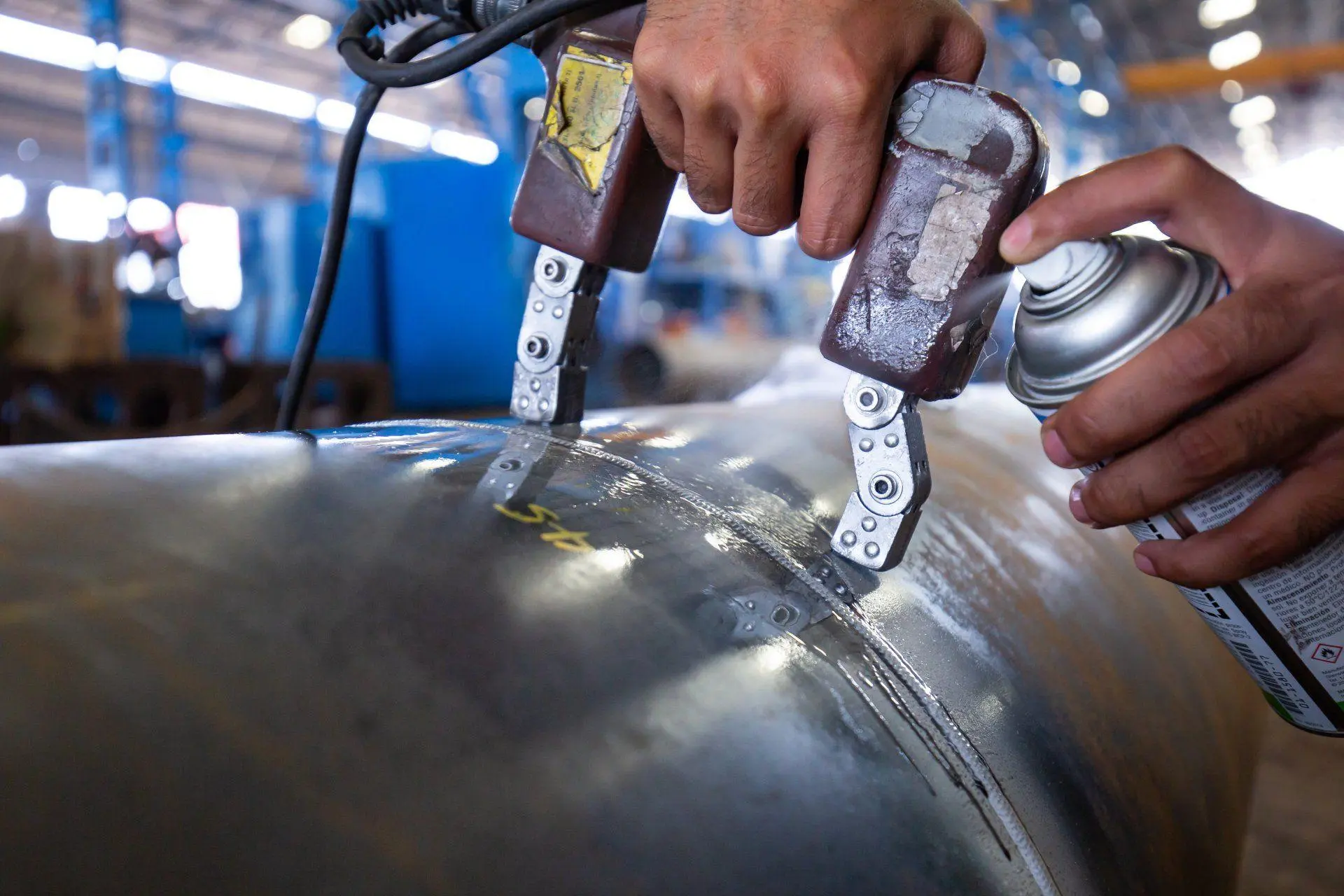
Our magnetic particle techniques
Yoke method
Portable electromagnetic yoke for welds and structures on site. The field is applied in two directions so flaws at any orientation are found.
Wet method
Particles in a liquid carrier, [visible or fluorescent under UV-A light], for high sensitivity on smooth surfaces and critical welds.
Dry powder method
Coloured dry powder for rough surfaces, hot parts and quick field checks [confirm what you offer].
Applications
- Weld toes and fillet welds
- Storage tank shell and nozzle welds
- Pressure vessels and piping welds
- Castings and forgings
- Lifting equipment and crane hooks
- Shafts, bolting and structural steel
Typical findings
- Surface cracks, including fatigue cracks
- Cracks in the weld and heat-affected zone
- Laps and seams in forgings
- Lack of fusion open to the surface
- Shallow subsurface flaws
- Grinding and quench cracks
Our magnetic particle process
Plan
Review the procedure, material, surface condition and acceptance criteria.
Clean
Remove paint, scale, oil and spatter from the test area.
Magnetise
Apply the field and the particles, in two directions.
Inspect
Examine under suitable light and tell flaws from false indications.
Report
Mark, photograph and record indications. Demagnetise if required.
Codes and standards we work to
| Standard | Typical use |
|---|---|
| ASME BPVC Section V, Article 7 [confirm] | Magnetic particle examination technique requirements |
| ISO 17638 [confirm] | Magnetic particle testing of welds |
| ISO 23278 [confirm] | Acceptance levels for magnetic particle testing of welds |
| ASTM E1444 [confirm] | Standard practice for magnetic particle testing |
| AWS D1.1 [confirm] | Structural welding code, MT acceptance of welds |
| ISO 9712 [confirm] | Qualification and certification of NDT personnel |
Only list the standards your procedures and personnel are approved for.
Frequently asked questions
What materials can MT be used on?
Ferromagnetic materials such as carbon steel and low-alloy steel. It does not work on austenitic stainless steel, aluminium or copper; dye penetrant is used for those.
Can MT find cracks under paint?
[Thin non-magnetic coatings are often acceptable within the procedure limits. Heavy or loose coating should be removed. Confirm what you offer.]
Does MT find internal flaws?
No. MT finds surface and shallow subsurface flaws. For internal flaws we use ultrasonic testing or radiography.
Does the part need demagnetising afterwards?
Sometimes. We demagnetise when the specification or the service of the part requires it.
Which countries do you cover?
[Tanzania, Kenya, Zambia and Rwanda.]
Need magnetic particle testing?
Tell us about the material, parts or welds you need tested and the applicable inspection code. We will reply with a quotation and inspection plan.
Request a Quote
Need magnetic particle inspection for your project? Contact our team to discuss your testing requirements.
Phone: +255 714 920 576
Website: ndttanzania.com
Get a Quote →